Journal / Paper Care
Paper Grain and Why It Cracks
A fold made against the grain looks fine for a while, then fails all at once along a line you could have predicted.
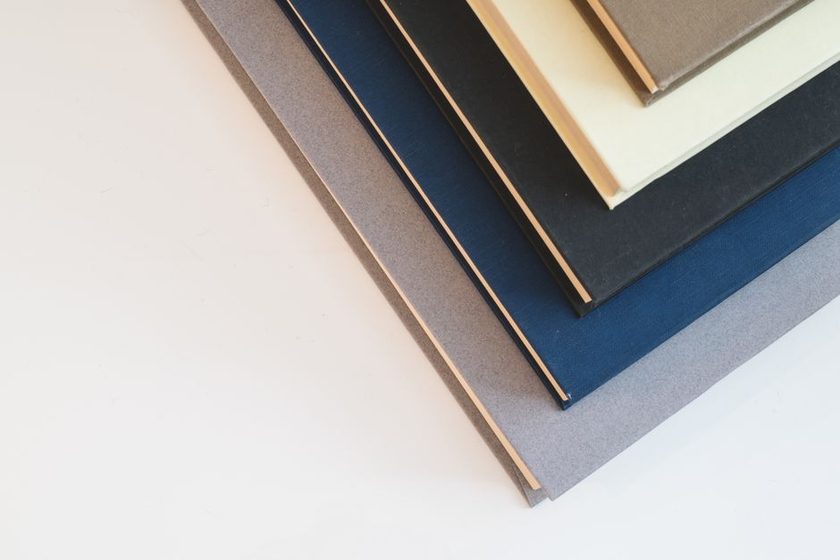
Fold a sheet of paper along a straight edge and it bends for you gladly in one direction, and fights you a little in the other, even though nothing about the sheet looks different from either side. That resistance is grain — the rough, mostly-parallel alignment of fibers laid down when the sheet was made — and it is one of the few properties of paper that stays invisible until the paper is asked to move. A fold made with the grain settles into a low, even crease that can take years of handling without complaint. A fold made against it looks identical on the day it's made — same crispness, same clean line, nothing to see. Then, weeks or months later, it opens along that exact line all at once, as if the sheet had simply decided to stop cooperating. It hadn't decided anything. It had been failing quietly the whole time, and the fold only showed the failure once enough fiber had given out.
What Grain Direction Actually Is
Machine-made paper is formed as a wet slurry of cellulose fibers moving fast down a screen, and the motion of that screen pulls most of the fibers into rough alignment with the direction of travel. The result is a sheet that is not uniform in any mechanical sense: it flexes more readily along that fiber direction, called the grain, and resists more stiffly across it. Cut a sheet so the grain runs parallel to the spine and a fold along that spine bends with the fibers, distributing stress along their length. Cut it the other way — grain running across the spine — and the same fold now asks each fiber to bend across its short axis, which is a very different mechanical demand and one paper tolerates far less gracefully.
Three Ways to Find It on the Bench
None of this requires a lab. Grain direction shows up in ordinary handling if you know what to watch for, and it's worth checking before any fold, hinge, or reinforcement gets committed to a sheet:
- The bend test. Hold the sheet loosely by two opposite edges and flex it gently, without creasing, first one way and then the other. It will curve smoothly and cheaply in the grain direction and push back stiffly across it.
- The wet test. Touch a barely damp fingertip to a small area near an edge and watch how it curls over the next few seconds. The sheet curls into a loose cylinder whose axis runs parallel to the grain, because paper expands more across the grain than along it.
- The tear test. Start a small tear from an edge in both directions on a scrap corner. A tear along the grain runs straight with little effort; a tear against the grain wanders, resists, and takes visibly more force to continue.
Why the Failure Is Delayed, Not Immediate
A cross-grain fold puts each fiber under a bending load it isn't built for, but a single fold rarely severs enough fiber to fail on the spot — the sheet simply creases, looking no worse than any other fold. The damage that matters happens underneath, at the bonds between overlapping fibers, which take on a small amount of permanent strain every time that line is opened and closed. Humidity swings widen the effect: paper expands and contracts unevenly across the grain as moisture moves through it, and a cross-grain crease sits at the exact point where that uneven movement concentrates. None of it shows on the surface. The sheet simply accumulates fatigue, fold after fold, cycle after cycle, until enough fiber bonds have given way that the line lets go all at once — which is why the eventual crack so often looks sudden to whoever is holding the book when it happens.
Against the grain, a fold doesn't fail because it was made badly. It fails because the paper was asked to bend across its own architecture, and it kept a quiet ledger of every time that happened — until the ledger came due.
| Trait | With the grain | Against the grain |
|---|---|---|
| Resistance felt while folding | Low, the sheet yields easily | Higher, then creases sharply once it gives |
| Appearance right after the fold | Clean, low, unremarkable | Clean — looks identical at first |
| Behavior over weeks of handling | Stable, crease keeps its shape | Fatigue builds invisibly beneath the surface |
| Eventual failure pattern | Gradual softening along the line | Sudden, often full-width, sharply straight |
| What a reinforcement strip should do | Can run either direction with less risk | Should run parallel to the sheet's grain, not the fold |
The wet test is the fastest of the three, but it's also the one most easily thrown off by dry shop air or paper that's already cockled from prior moisture exposure. When the bend test and the wet test disagree, trust the tear test — it reads the fiber structure directly rather than inferring it from surface movement.
Reading Grain in Handmade or Older Stock
Machine-made sheets are the easy case, because the Fourdrinier screen imposes a single, consistent grain across the whole roll. Handmade and mould-made papers are less obliging. A sheet formed by hand, with fibers shaken loose across a mould in irregular strokes, can carry a grain that is only mildly directional, or that varies subtly from one region of the sheet to another. On stock like this, the bend and wet tests can give a faint or ambiguous answer, and the tear test earns its keep — a short trial tear in an inconspicuous corner will usually still show a clear preference, even when the sheet feels evenly floppy in every direction by hand alone. Assuming a strong grain where none really exists is its own kind of mistake, since it leads to over-engineering a repair for a failure mode the paper was never especially prone to.
What Grain Determines Once You Know It
Knowing grain direction changes several decisions downstream, not just whether a given fold is safe. It sets which way a reinforcing strip should run relative to a damaged sheet, since a strip laid across the grain of a cross-grain fold reinforces exactly nothing about the underlying weakness. It also changes how a torn edge should be read in the first place — a straight, sharp-edged crack is far more likely on cross-grain paper than a soft, wandering one, a distinction covered in more depth in Reading the Broken Fold. And it affects material choice further along the repair, since heavier or lighter support material behaves differently depending on how much cross-grain stress it needs to absorb, which is part of why grain gets checked before Choosing Thread Weight for Old Paper is even decided. Skipping the check doesn't make the grain go away — it just means the eventual crack arrives as a surprise instead of a prediction.
This entry describes how grain direction is checked and reasoned about on the bench before repair — it is a record of a working process, not a substitute for hands-on training. Paper stock varies by furnish, age, and manufacture, and any sheet that behaves unexpectedly under these tests is worth slowing down for.